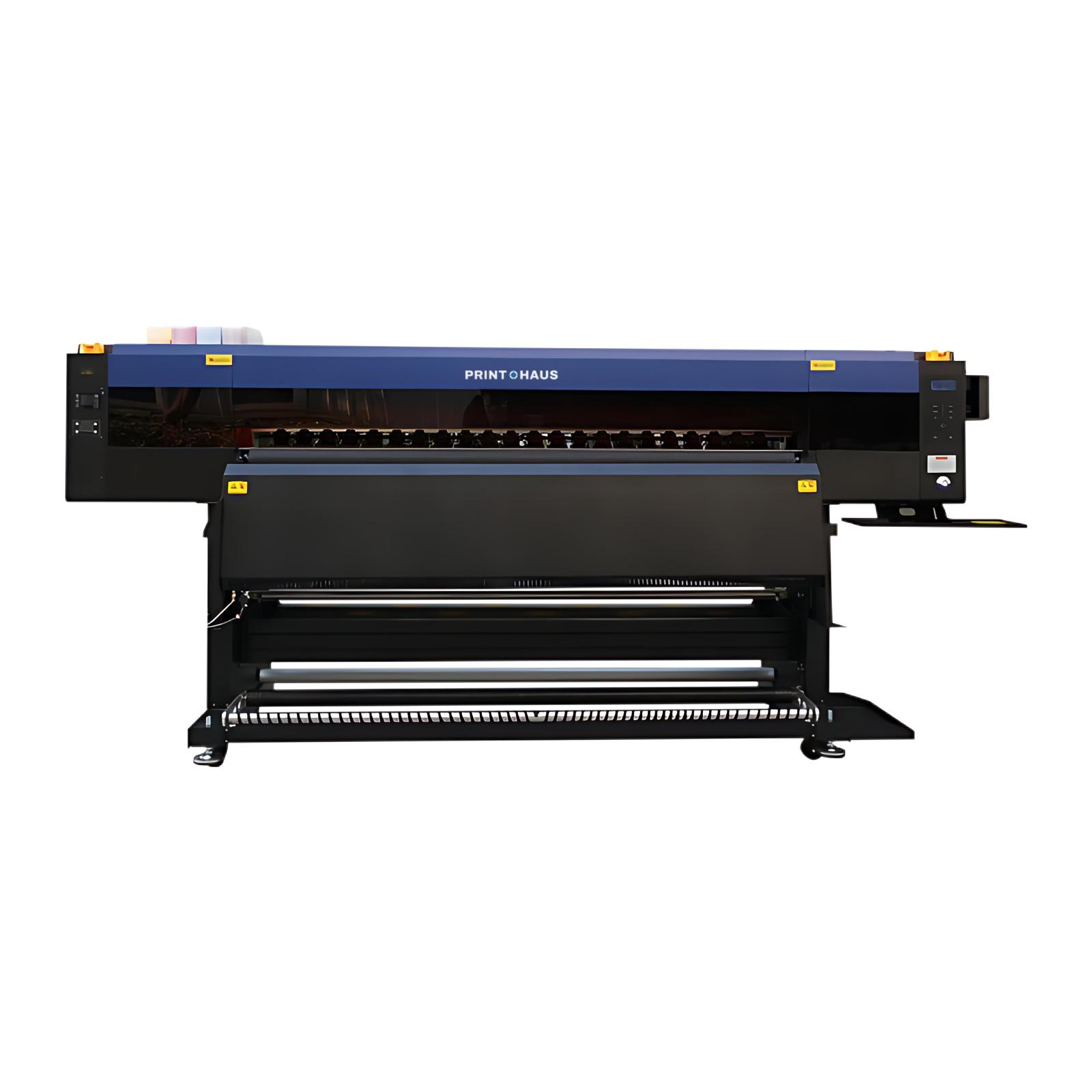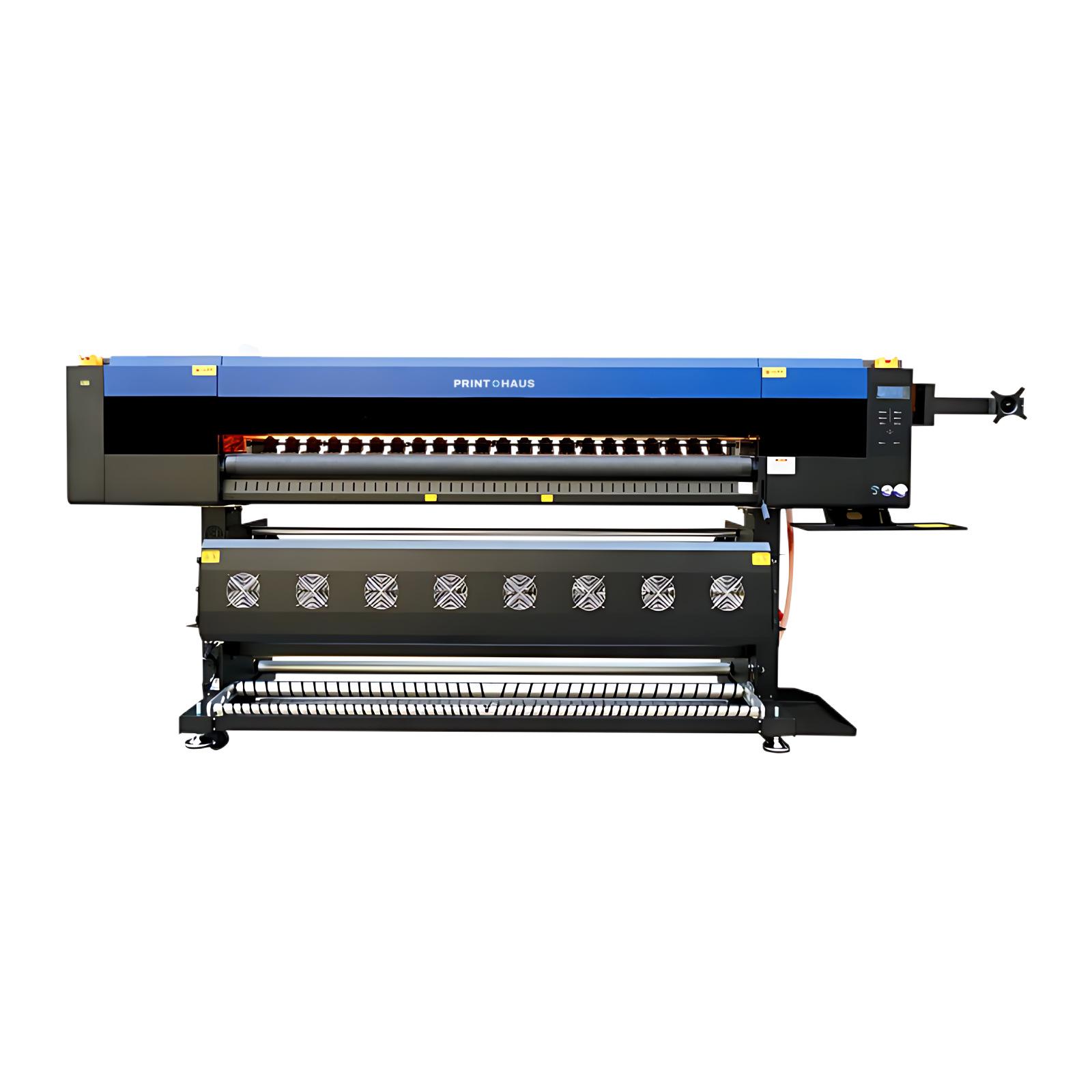
A large-format sublimation printer is the core of a sportswear, flag or soft-furnishing business. It prints dye-sublimation paper on wide rolls. Heat then turns the dye into gas, which bonds into polyester. The colour becomes part of the fabric: it doesn't crack, peel or wash out, and the fabric still breathes. That is why team kits and performance wear are printed this way.
What to look at when choosing one
Print width
Most production printers are 64–75 inches (1.6–1.9 m) wide. Wider paper means fewer seams on flags and soft furnishings, and more garment panels per metre. Match the printer to your calender or press width.
Head count and real speed
Speed grows with the number of heads, and with fewer passes. Rated speeds of our two machines, both with Epson i3200 heads:
| PH-SB194 (4 × i3200) | PH-SB188 (8 × i3200) | |
|---|---|---|
| 1 pass | — | up to 3,444 ft²/h |
| 2 pass | up to 1,938 ft²/h | up to 1,722 ft²/h |
| 4 pass | up to 969 ft²/h | — |
Manufacturers define passes differently, so compare machines at the quality you will actually print. Quoted speeds are rated speeds. Real output depends on pass count, image coverage and how fast you can feed the calender behind the printer.
Paper handling and drying
For long unattended runs, look for constant-tension feed (servo motors with tension sensing), a sturdy take-up with an inflatable shaft, and double drying, so the ink is dry before the paper rolls up. Paper-shortage detection helps too. Poor tension shows up as banding and misregistration, which is costly on numbered team kits.
Ink supply
Bulk tanks (around 3.5 L per colour) with secondary cartridges let a printer run a full shift without refilling. Use dye-sublimation ink matched to your paper and your ICC profiles.
Power
Sublimation printers draw most of their power for the dryers: several kilowatts, at 220V. Plan the circuit, and the calender's power, before the machine arrives.
Our sublimation printers
- PH-SB194: 75 in (1,900 mm) wide with four Epson i3200-A1 heads. Up to 969 ft²/h at 4 pass and 1,938 ft²/h at 2 pass. Double drying, constant-tension feed and THK linear guides. $15,990 delivered and duty paid. The step up for shops whose desktop sublimation printers are full every day.
- PH-SB188: 72 in (1,820 mm) industrial printer with eight i3200 heads. Up to 1,722 ft²/h at 2 pass and 3,444 ft²/h at 1 pass. 3.5 L tanks, tension-sensing servo feed and paper-shortage detection, and several printers can run from one PC. $22,990 delivered and duty paid. For textile and home-decor production keeping a calender busy all shift.
Is sublimation the right process?
Sublimation is unbeatable on white and light polyester. It cannot print on cotton or dark garments. For those, look at DTF. Our DTF vs sublimation vs DTG guide compares the three processes.
What comes with it
Every US price includes sea freight to your door, customs clearance and import duty. It also includes online setup and operator training, a 12-month machine warranty and remote video support for as long as you own the printer. Tell our chat your fabric, width and daily volume, and we'll tell you which printer fits.